
Welcome to the 2026 Chesapeake Bay Internship Program (CBIP) Intern Symposium page!
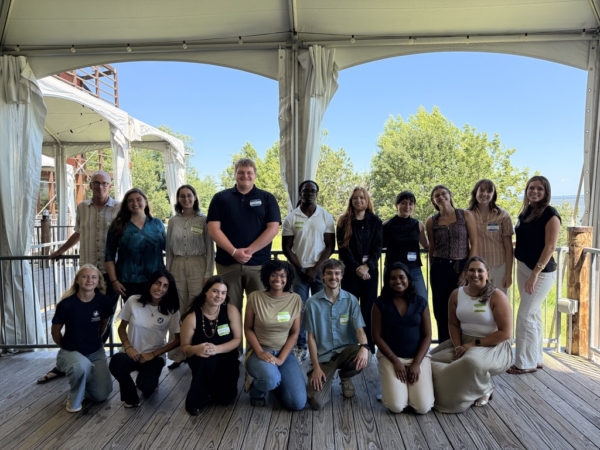
At the beginning of August 2026, CRC held our first annual CBIP Symposium at the Chesapeake Bay Foundation’s Philip Merrill Environmental Center. Interns in the CBIP cohort, representing our partner organizations, gave impactful presentations on their internship activities and accomplishments in front of an audience of peers, mentors, and attendees from across the Chesapeake Bay Region. You can view the student presentations and abstracts below. The intern’s projects reflect the priorities and expertise of the host organizations.
Intern Presentations
Ru Subramaniam – University of Maryland, College Park
Internship: Monitoring Intern, Arundel Rivers Federation
Arundel Rivers Monitoring Internship: My poster focuses on my role at the Arundel Rivera Federation this summer, as I assisted in collecting water quality data, collecting water samples for bacteria testing, and assisting in our SAV restoration program. I also discuss my capstone project and the importance of the work that is done at ARF.
Kaelonnah Darlich – The Pennsylvania State University
Internship: NOAA Marine Biologist Intern, NCBO Cooperative Oxford Laboratory
Detecting Vibrio spp. in the Delaware River and Fish Community Surveys to Support Coastal Ecosystem Health and Resilience in Oxford, Maryland: Coastal ecosystems are facing increasing pressures from climate change, sea-level rise, and environmental variability. NOAA research uses biological monitoring to investigate naturally occurring Vibrio spp. in the Delaware River and fish communities across living shorelines, barrier islands, and natural beaches in Oxford, Maryland. Together, these findings support pathogen forecasting, seafood safety, habitat assessment, and the development of nature-based coastal resilience strategies in the Mid-Atlantic.
Elizabeth Moty – The University of Vermont
Internship: Field Technician Intern, NCBO
A Deep Dive into NOAA Fisheries: Monitoring Hypoxia, Bay Conditions, and Sediment Mapping: Assisted in the maintenance of the Chesapeake Bay’s hypoxia monitoring program and the Chesapeake Bay Interpretive Buoy System (CBIBS) through field operations, sensor maintenance, and quality assurance. Additionally providing updates to the Chesapeake Bay’s Coastal and Marine Ecosystem Classification System map product by incorporating new bathymetric data and oyster restoration information.
Ruby Ondatje – University of Maryland, College Park
Internship: Science Education Intern, NCBO
Environmental Education Throughout the Watershed: As the Science Education Intern for the NOAA Chesapeake Bay Office, Ruby Ondatje supported educator programs focused on Chesapeake Bay Program endorsed environmental literacy models. To further support these models, Ruby created a Chesapeake Watershed Phenomenon Database, featuring local events and resources to assist formal and informal educators across the watershed.
Sydney Hall – University of Maryland, Baltimore County
Internship: Education and Outreach Intern, Arundel Rivers Federation
Green Careers Fair: Introducing students to careers in the environmental field: Entering the work force can be difficult and overwhelming without the support or knowledge needed to navigate your chosen profession. This summer, I hosted an event at Quiet Waters Park to introduce students to careers in the environmental field, all while touring two completed restoration sites. This gave students tangible examples of work that can be done in the environmental field, as well as introduced them to established professionals to begin building their network and thinking about their futures.
Oluwole Okusanya – Towson University
Internship: Computer Science Intern, NCBO
Visualizing The Chesapeake: Data Engineering for the Chesapeake Bay Interpretive Buoy System: This summer at NOAA’s Chesapeake Bay Office, I developed a suite of Python-based visualization pipelines for the Chesapeake Bay Interpretive Buoy System (CBIBS), including multi-station wind and wave rose plots built from a class-based architecture supporting multiple time windows. I also built squeeze plots illustrating the relationship between dissolved oxygen and temperature at Sharps Island across multiple seasons, helping visualize conditions relevant to species-specific environmental thresholds in the Bay. Together, these tools give researchers and the public a more accessible, repeatable way to explore Bay conditions from buoy data.
Kate Koblegarde – New York University (NYU)
Internship: Environmental Economics Intern, NOAA
Oyster Restoration Economics of The Chesapeake Bay: Ecosystem Valuation, Restoration, and Implementation of Financing Future Initiatives: Analyzing ecosystem valuation by synthesizing nitrogen and phosphorus filtration data, economic models and restoration costs of oyster reefs in the Chesapeake Bay. For the future of Bay oysters, I have designed a prospective tax deductible to adopt a reef program titled Chesapeake Reef Guardians. My goal is to design markets to incentivize financing the future of oyster conservation.
Cassidy Martin – St. Mary’s College of Maryland
Internship: Box Turtle Researcher, Jug Bay Wetland Sanctuary
Population Demographics of Eastern Box Turtle (Terrepene carolina carolina) at Emory Waters Nature Preserve: I added over fifty box turtles to the extensive database at Jug Bay Wetlands Sanctuary. This data was gathered from a previously unsurveyed area that will soon undergo a stream restoration project. My data on the heath and demographics of these turtles will provide valuable information that will allow the stream restoration’s impact on the box turtle population to be measured.
Wyatt Palenchar – University of Maryland, Eastern Shore
Internship: NERTO Graduate Intern, NCBO
Utilizing eDNA for fish community analysis at NBS restoration sites: Oxford, MD is threatened by shoreline erosion and flooding due to changing environmental conditions. The town has implemented both grey and blue-green infrastructure to help with this issue, including recently constructed nature based solutions. This project works to understand how fish species may be using these different sites through the use of eDNA collected from water samples.
Cheyenne Murdaugh – University of Maryland, Eastern Shore
Internship: NERTO Graduate Intern, NCBO
Analyzing Benthic Invertebrate Communities At Restoration Sites With Nature-Based Solutions: As a part of the larger Strand project, my internship focuses on the macrobenthic invertebrate community composition around Oxford, Maryland. By collecting samples at different shoreline restoration sites around Oxford and the Tred Avon River, we hope to see how shoreline restoration effects the benthic community.